
In Brief: Key Takeaways
People reach for honey for coughs, sore throats and winter colds, but the qualities they value in it (enzymes, antibacterial activity, antioxidants, pollen and propolis) are found mainly in raw honey. Most supermarket honey has been heated and filtered on its way to the shelf, and it does not do the same job. The benefits covered in our articles on honey and immune support and pure honey for winter immunity depend on which jar you pick.
What “raw” actually means
Honey straight from the hive contains more than sugar. Chris Kresser lists enzymes, proteins, trace minerals and polyphenols among its components, and uses them to explain why honey acts differently in the body from refined sweeteners with a similar sugar profile.
“Raw” describes honey that keeps these compounds because almost nothing has been done to it. It has not been pasteurized or finely filtered, nothing has been added, and the only treatment is straining out bits of wax. Dr. Josh Axe puts the heat limit at about 35°C (95°F), close to the temperature bees keep inside their hive. Left this close to its natural state, raw honey also holds small amounts of bee pollen and propolis, the resin bees use to seal their hive.
What processing does to honey
Commercial processing serves appearance and shelf life, and each step takes something out.
Heating and pasteurization
Heat keeps honey runny and slows crystallization, at the cost of its enzymes and some of its vitamins and minerals. Kresser warns that honey pasteurized at high temperatures, or ultrafiltered, ends up with far less of the nutrition that made it worth choosing.
Fine filtering
Straining removes wax. Fine filtering goes further and takes the pollen and propolis out as well, which is how honey becomes bright and transparent enough for many shoppers to assume it is the purest kind. Axe notes that pasteurized honey contains essentially no pollen – worth knowing if you buy local honey hoping it will help with seasonal allergies.
What the bees are fed
Axe also notes that bees producing regular commercial honey may be fed sugar or inexpensive syrup through the winter.
Processed honey keeps all of its sugar and loses much of what made it worth eating. In terms of the Health Equation, the balance between what supports your body and what burdens it, that makes it a withdrawal from your health account rather than a deposit, much like other refined sweeteners.
The practical differences
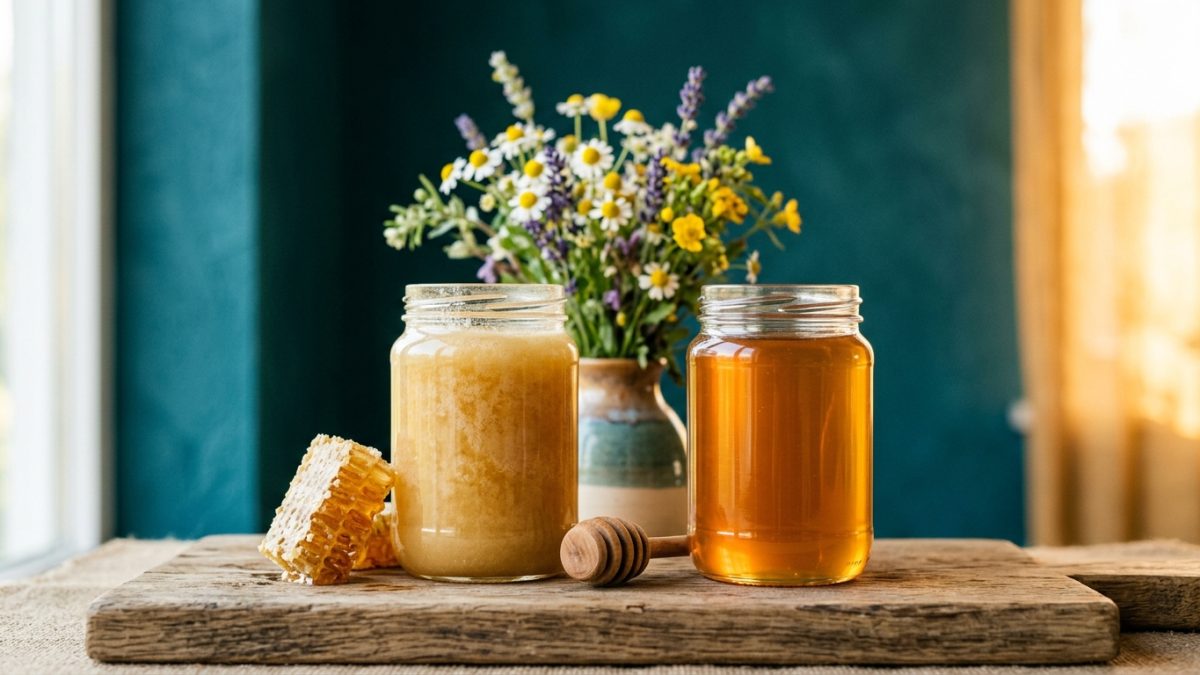
Raw honey is usually cloudy or opaque, sometimes with tiny specks of pollen or wax, and it thickens and crystallizes over time. Its color and flavor depend on the flowers the bees visited, from light acacia honey to dark buckwheat honey. Processed honey tends to look the same from jar to jar: bright, clear and runny.
How to identify raw honey
Words on the label
Look for “raw,” “unheated,” “unfiltered” or “unpasteurized.” “Pure,” “natural” and “100% honey” say nothing about whether the honey was heated or filtered. According to Axe, honey sold as organic is usually raw too, with the same heating limit, though the exact rules depend on each country’s organic standards.
When it turns solid
Crystallized honey has not gone bad, since crystallizing is a natural process. To make it runny again, stand the jar in a bowl of warm water (below 35°C/95°F) instead of heating it on the stove or in the microwave.
Questions to ask a beekeeper
Kresser and Axe both recommend local sources such as beekeepers and farmers’ markets, and buying directly means you can ask how the honey was handled:
- Was the honey heated at any stage, and to what temperature?
- Was it only strained, or also filtered?
- Do the bees get sugar or syrup over the winter?
If you have a choice of honeys, Dr. Mark Hyman suggests the darker ones for more protective compounds.
Keep it away from heat
Axe advises against cooking with raw honey or keeping it beside the stove, so add it to tea only once the tea is cool enough to sip, including when you take honey for a cough.
Who should avoid honey
The one firm rule is age: no honey of any kind, raw or processed, before a baby’s first birthday. Honey may contain botulism spores, and Axe points out that the danger is limited to infants; older kids and adults are not at risk from them.
For anyone managing diabetes, insulin resistance or unstable blood sugar, raw honey still counts toward the day’s sweeteners. Hyman points out that it is made of glucose, fructose and sucrose like other sweeteners, and that people recovering from diabetes or obesity may need to cut added sweeteners sharply or set them aside for a while. A practitioner who knows your history can help you decide whether honey fits, and in what amount.
Because raw honey contains pollen, anyone with a pollen or bee-related allergy should be cautious with it. People with weakened immunity, or those undergoing chemotherapy or radiation, should check with their care team first.
Choosing honey that works with your body
Your body has its own ways of keeping itself well, and food either supports them or adds to the load. Raw honey in small amounts can be part of that support. Buy from someone who can tell you how the honey was handled, keep it away from heat, and use it sparingly. Everyone responds to sweeteners differently, so notice how your own body reacts and adjust from there.